Viperball
A gridiron sport I invented, with a rulebook, a simulation engine that plays it, and a 280-team universe to play it in.
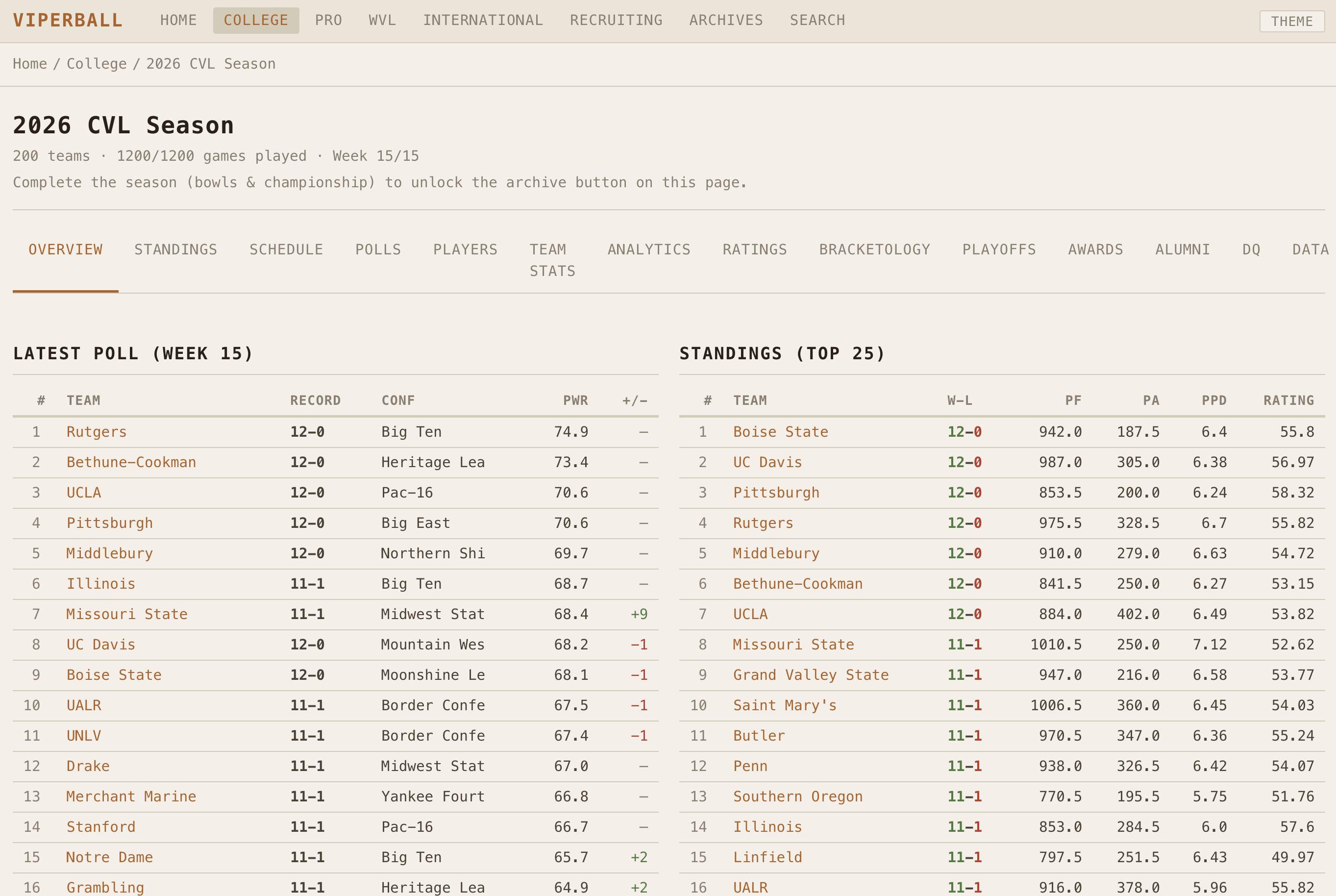
Viperball started as a hypothetical in a Reddit thread: what would football look like if it had evolved from the pre-forward-pass era, with kicking-led, two-way play and lateral chains carrying the ball forward? I answered it in full: I designed the sport, wrote its rulebook, built a simulation engine that plays it, populated a 280-team universe to play it in, and shipped four different ways to watch it happen.
It’s really six projects: a sport, a simulation engine, a generated world, and three interfaces onto them.
The sport
An invented game with an internally consistent rulebook.
Viperball is a gridiron code with its own logic: six downs to gain twenty yards, with the ball moving by running, lateral chains, and kick passes (a kicked ball to a downfield teammate). Its six-channel scoring system makes a touchdown worth 9 and a live-play drop kick worth 5, and a half-point “bell” rewards a loose-ball recovery. There’s a position native to the sport, the Viper, a pre-snap-motion mismatch machine, along with a sixth official invented to govern it.
The hard part was keeping it coherent. Every rule creates a strategy, every strategy needs a counter, and a coach has to be able to scheme around the whole thing. The full rulebook runs to dozens of pages: field, clock, penalties across five phases of play, weather, overtime, officiating.
The ruleset lives in README.md and RULES.md.
The simulation engine
A contest-based stochastic model that turns rules into believable games.
Every yard, catch, and kick is a contest between specific players’ attributes, resolved with probability. The rule that makes games feel real is that skill proximity creates variance. Evenly matched players produce wild play-to-play swings, and a mismatch produces consistent, grindy outcomes. On top of that sit hot streaks that narrow a player’s variance toward the high end, a fatigue cliff that forces real depth-chart usage, a kicker-range model where the kicker’s rating sets the range, weather effects, and nine distinct offensive schemes that reshape the underlying math.
~14,500-line core · pure Python · a tuned probability model.
The world
280+ teams across four leagues, most of them procedurally generated.
The sport needed teams, so I generated them: a 187-team women’s collegiate league mapped onto real universities, plus pro, women’s-pro, and international circuits. Each team is a structured record with a 36-player roster, ratings, an identity, and a recruiting pipeline. Generation scripts produce region-aware names, coaching staffs, referees, and rosters at scale, so the world can grow without hand-authoring every player. Multi-season dynasty mechanics run on top: recruiting, a transfer portal, signing day, coach hiring and firing, polls, awards, and bowl games.
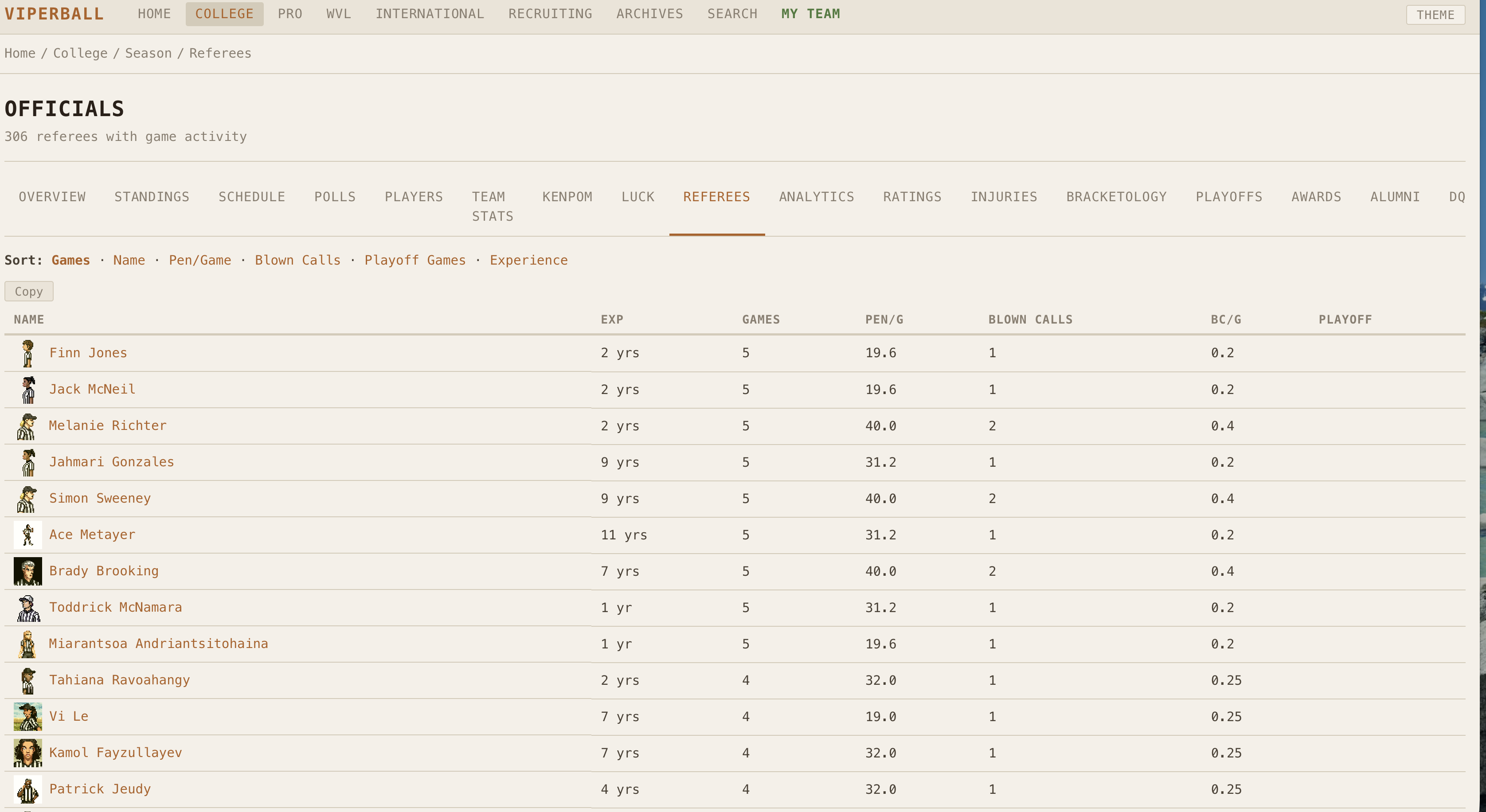
~280 team records · 4,500+ players · JSON-backed · procedural name / roster / staff generators.
The interactive app
A play-it-yourself sim: call plays, run a dynasty, act as commissioner.
This is the hands-on interface where you advance a season week by week, manage a program, or run a whole league as commissioner. Built in NiceGUI (a Python-native, Vue-backed UI framework) and served alongside the API in a single process, it covers play-calling, dynasty management, draft and free-agency flows, and a multi-league spectator mode, all reading live from the simulation engine.
NiceGUI (Vue under the hood) · Plotly charts · FastAPI + uvicorn, single-process · deployed on Fly.io.
The stats terminal
A terminal-style stats portal for a fictional sport.
The public face of the project: a fast, keyboard-driven, server-rendered stats site that updates in real time as simulations run. College, Pro, WVL, and International sections; box scores, standings, player leaderboards, recruiting, and archives. It is the statistical record a real league would keep, for a sport that doesn’t exist. It ships with a rack of switchable themes (Bloomberg Light, Navy & Ivory, Dark Ocean, CRT, Solarized) and “?” keyboard shortcuts.
FastAPI sub-router · Jinja2 server-side rendering.
The method
Design specs and after-action reports for every major system.
I keep decision records for major changes and run batch simulations to see what the rules actually produce. One after-action report traces a nasty mistake: after an interception, the engine gave a bonus possession to the team that threw the pass. The game kept running and producing stats, but the rule worked backward. Fixing the assignment meant rerunning the season. The report records the affected statistics and the test the engine needed.
30+ specs and after-action reports · 200+ game validation batches.
Stack
Python 3.11 · FastAPI · NiceGUI · Pydantic · Plotly · Jinja2 · pandas / numpy · Docker · Fly.io.
Roughly 120,000 lines of Python across the engine, four frontends, the data universe, and the generation tooling.
Writing
A three-part series in Sideline Engineering, the newsletter where the design history of Viperball lives.